We’ve all noticed it in recent years: extreme weather is becoming more frequent and severe. Heavy rains and floods are striking communities across Europe, causing serious damage. Luxembourg is no exception and faces growing risks from severe storms and floods.
To address this, Prof. Rebecca Teferle and her team at the University of Luxembourg launched the NWPLux Project in collaboration with RSS-Hydro. Their goal is to develop a weather prediction system tailored specifically to Luxembourg, a tool designed to help authorities and communities prepare for extreme weather events before they happen.
Luxembourg already lies on European and international weather data, but the NWPLux project takes forecasting a step further. It delivers a Numerical Weather Prediction (NWP) model, the first high-resolution weather prediction tool built specifically for Luxembourg and the surrounding region. The system not only provides conventional forecasts every six hours but will also use nowcasting – a method of very short-term weather prediction (every 30 minutes/1 hour) that helps authorities respond quickly to heavy rainfall and supports real-time flood warnings. This combination of conventional forecasting and nowcasting creates a tool that can be directly applied to the real world.
Over the past three years, NWPLux has made significant progress. The team has implemented the NWP system using the Weather Research and Forecasting (WRF) model, an open-source scientific framework. The system runs on Luxembourg’s high-performance computing infrastructure, covering the country and the surrounding Greater Region at a fine resolution of 1.3 km, while extending across Europe with a resolution lowering to 12 km. This allows temperature and rainfall predictions to be generated for every 1.3 km square in Luxembourg.
By setting up data assimilation (WRFDA) with regional observations, the team has been able to improve the accuracy of forecasts. The model has been carefully tested against multiple datasets, including satellite imagery and radar data and local measurements, for major flood events in 2016, 2018 and 2021, showing clear improvements in predicting both rainfall and temperature. In the case study of the 2021 flood event, a one-month simulation reveals that using local data, compared to not using it, significantly improves precipitation detection. The team achieved a Probability of Detection (POD) improvement of +8.3% and a substantial reduction in False Alarm Ratio (FAR) by −13.7%.
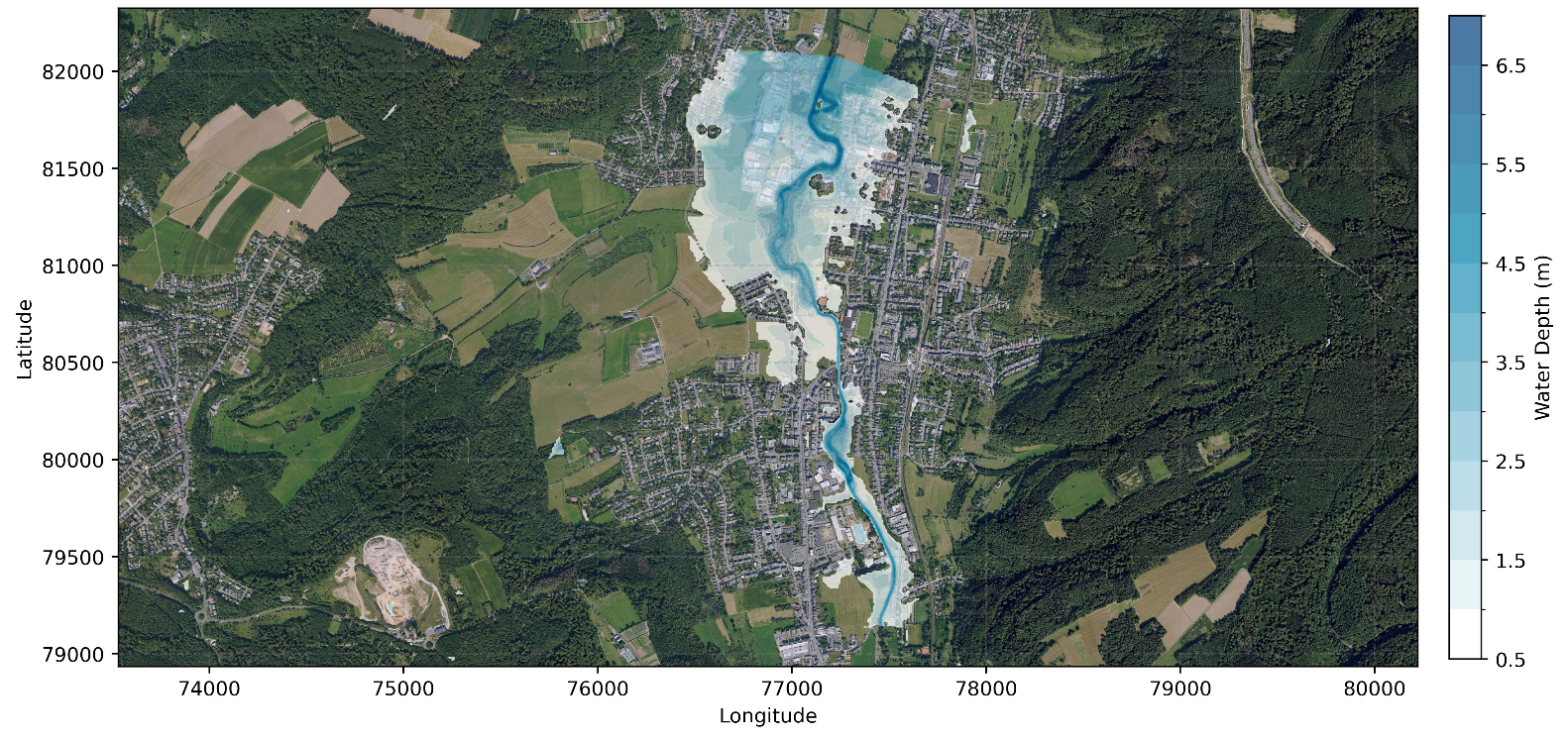
To better understand the consequences of heavy rainfall, the system has been linked to the LISFLOOD-FP Hydrodynamic model, a scientific flood simulation software, which has been tuned for Luxembourg and takes the NWP rainfall forecasts and simulates how water flows across rivers, valleys, and towns. This integration produces detailed maps of flood extent and depth, giving authorities and stakeholders a clear view of both the rain and its potential impact.
The NWPLux project also demonstrates the value of collaboration between academia and industry. As Prof. Rebecca Teferle explains, “The University of Luxembourg leads the scientific development and validation of the WRF model and its data assimilation component, while RSS-Hydro brings expertise in flood modeling and operational forecasting of water levels. It’s a strong example of how academic research and industry know-how can come together to deliver real impact in the real world.”
Looking ahead, the plan is to turn NWPLux into an operational tool that RSS-Hydro can use as part of its commercial services. This would make real-time, high-resolution flood forecasts available not just in Luxembourg but potentially across the region. RSS-Hydro will manage weather data licenses and continue to develop the system, while follow-up funding, for example through the FNR BRIDGES programme, could support its transition from research project to operational service.