As Ibec’s Director of EU and International Affairs, you represent Irish business at a time when Europe is rethinking its competitiveness, resilience and place in the world. Ibec was also closely engaged with the Irish Government ahead of Ireland’s Presidency of the Council of the EU, which gives you a particularly valuable perspective on what this Presidency can deliver. From your point of view, what would a successful Presidency look like for business?
A successful Presidency will drive forward an EU that is more competitive, resilient, innovative, simplified, focused, ambitious and outward-looking. We must champion a rules-based international trading system and maintain close dialogue with key partners in Washington DC and London while simultaneously pursuing new trading alliances.
Advancing the regulatory simplification agenda is vital to enhance productivity, foster innovation and reduce compliance costs for enterprise. We need to see the delivery of comprehensive omnibus packages across digital and environmental areas to substantial reduce administrative burdens and unleash business potential.
We must demonstrate a robust commitment to Single Market integration and advance the savings and investment union to unlock cross-border private capital for scaling businesses and critical infrastructure. One area of potential contention is the Industrial Accelerator Act. For Ireland and many other EU Member States the ability to participate in global supply chains, attract foreign direct investment and compete on open markets is critical. Domestic subsidy races and protectionist procurement mandates represent a dangerous economic pivot, with short term gains being offset by negative impacts on medium to long term growth rates.
Ireland and Luxembourg are both small, open economies whose prosperity depends heavily on the Single Market, international trade, investment and regulatory predictability. This is why our organisations place strong emphasis on strengthening the Single Market and advancing regulatory simplification. There has been no shortage of reports, strategies, political declarations and promising proposals, but in several areas concrete progress still feels too slow for businesses. Where do you think the Irish Presidency should focus its efforts to reduce fragmentation, improve implementation and ensure more uniform transposition of EU rules, so that simplification becomes a reality for companies?
The Irish government has come out strongly on its commitment to advancing practical action to enhance productivity, with a focus that closely mirrors the recommendations set out in the Mario Draghi report. A major focus of the Irish Presidency should be on making real progress on the comprehensive omnibus packages and getting as many of them over the line as possible. To meaningfully develop the Single Market, efforts need to be directed at addressing the terrible 10 barriers that continue to fragment the free movement of goods, services, labour and capital. We need to move beyond promising proposals by achieving greater harmonisation and uniform transposition of Single Market rules, while committing to shared responsibility for application and enforcement so that simplification becomes a reality for companies. Ultimately, all these efforts must focus on making sure that the EU becomes more competitive and remains open to business. It is also important to ensure quality and consistency in the application of the Better Regulation principles, such as ‘one in, one out’ and pre-legislative competitiveness checks.
During and beyond its Presidency, Ireland has an opportunity to reinforce the competitiveness and Single Market agenda by chairing the High-Level Group on Competitiveness and Growth for 18 months, the Council’s Working Party on Competitiveness and Growth, and all subgroups of the working party.
Looking beyond the Single Market, today’s more fragmented geopolitical environment is pushing the EU to strengthen its economic security and industrial capacity. For economies like ours, which depend so much on openness, what is your view on “open strategic autonomy”? How can Europe diversify its trade and investment partnerships while remaining outward-looking and avoiding protectionist reflexes?
Effective strategic autonomy must include a firm commitment to openness. Open and rules-based trade is critical for maintaining competitive and sustainable Irish and European economies. While Europe needs to strengthen its industrial base to reduce exposure to risks, this must be done intelligently and selectively, balancing openness with economic security to avoid introducing measures that restrict trade and investment. With 85 percent of future economic growth predicted to take place outside of Europe, a proactive and outward-looking common trade policy remains one of our most powerful assets.
We need to be careful that European preference criteria, as proposed in the Industrial Accelerator Act, do not cut us off from future levers of growth. Preference criteria should be narrowly focused on real security threats and our approach should be ‘Make with Europe’ rather than ‘Make in Europe’. A pivot towards protectionist policies will damage the resilience and competitiveness of the EU.
To diversify our partnerships, we need to continue advancing and supporting new free trade agreements. We should accelerate FTA implementation and negotiations, for example with the Philippines and Indonesia, to further diversify market opportunities for European business. The provisional application of trade agreements, such the EU-Mercosur agreement. offer significant opportunities in a range of sectors. This is evidenced by the experience of the EU-Canada agreement, the success and ratification of which will a focus during the Irish Presidency.
Beyond traditional free trade agreements, we should continue to develop bilateral partnerships focusing on critical raw materials and digital trade rules.
Ireland has a particularly close relationship with both the United States and the United Kingdom, shaped by deep historical, cultural and economic ties. On the US side, you also chair BusinessEurope’s United States Network. The transatlantic relationship remains one of Europe’s most important economic partnerships, while also being increasingly exposed to trade tensions, tariffs and geopolitical uncertainty. How should the EU strengthen cooperation with the US on trade, investment and global challenges, while remaining united in defending its economic interests?
The full implementation of the EU-US Joint Framework Agreement, should facilitate a return to a more stable relationship with the US, bringing tariffs on EU goods back to the agreed all-inclusive 15% maximum. The European Commission and USTR (United States Trade Representative) should work together to reduce the cost of transatlantic trade. The deal safeguards European interests, while ensuring the EU respects its commitments under the Turnberry agreement. The expectation is also that broader bilateral discussions on critical issues such as steel derivatives, tariff exemptions and resolving ongoing USTR investigations, can now see meaningful progress.
We should focus on tackling shared global challenges and fostering closer cooperation. This can be done through advancing channels for dialogue like the Critical Raw Materials Memorandum of Understanding, the ‘Steel ring-fencing’ agreement and the EU-US Digital Dialogue. Our priority must be finding ways to eliminate tariffs and non-tariff barriers wherever possible instead of increasing duties.
The transatlantic relationship remains one of central economic importance for both the Irish and European business community. Ireland has traditionally acted as a strong interlocutor in this dynamic and the Ireland’s EU presidency is an opportunity to carefully balance and advance these crucial transatlantic ties. The EU must continue to champion a rules-based international trading system.
Turning to the UK, Ireland remains deeply connected with its closest neighbour and key trading partner. In the post-Brexit context, where do you see the main opportunities to strengthen EU-UK cooperation, and what role can Ireland play in that conversation, particularly when it comes to Northern Ireland and cross-border economic links on the island of Ireland?
The EU-UK relationship is another area of importance, not only for Irish business but for many businesses across the EU. It is important that we delicately balance the post-Brexit EU-UK relationship while maintaining close dialogue with London. The 2026 review of the Trade and Cooperation Agreement presents a significant opportunity to build closer economic relations with the EU’s third-largest trading partner and address regulatory divergence. The upcoming EU-UK Summit, postponed following Prime Minister Keir Starmer’s resignation announcement is expected to provide further momentum to the post-Brexit reset in bilateral relations. Chief among these is the Sanitary and Phytosanitary (SPS) Agreement, already partially agreed. Discussions will also focus on the establishment of an emissions trading system enabling UK alignment with EU carbon pricing mechanisms. Made with Europe provisions and a steel alliance could also form part of discussions.
When it comes to Northern Ireland, the EU must be sensitive to the all-island economy and systematically integrate Northern Ireland’s unique post-Windsor Framework position into EU policymaking. We need practical solutions for complex all-island supply chains, such as those operating across the border in the dairy, alcohol, and retail sectors. An example of these complexities can be seen in the UK and EU’s new steel measures, where, in some scenarios, products being imported into Northern Ireland are effectively exposed to charges under both systems.
Digitalisation and AI are central to Europe’s competitiveness agenda. Our organisations call for a simpler and more coherent EU digital rulebook, greater AI adoption and innovation, and investment in key enablers such as compute infrastructure, networks and skills, while defending a smart approach to digital sovereignty. At the same time, the recent US decision affecting foreign access to some of Anthropic’s most advanced AI models has revived the debate on technological sovereignty and the need to reduce strategic dependencies. What is your view on this? Should Europe see it as a signal to build more autonomous AI capabilities, or rather as a reason to deepen cooperation with like-minded partners around trusted data flows, interoperability and clearer rules?
Europe must maintain an open and ambitious digital trade agenda combined with a smart approach to economic security and resilience. We can remain open to international cooperation with likeminded partners, while actively encouraging the creation of autonomous capacities across Europe. To ensure we are not entirely dependent on external models, Europe must enable complementary investments in compute infrastructure, digital connectivity, and energy networks. Funding must also be heavily targeted toward the research and innovation nexus, as well as digital and AI skills, which are the foundations of a thriving digitalised economy. The EU must focus on simplifying its digital rulebook to create an efficient, and coherent framework to unlock internal AI competitiveness. Moving forward, the current framework must be assessed with a high threshold for further legislation to avoid costs, confusion, and fragmentation for businesses.
Instead of turning inward, the EU must support trusted international data flows while maintaining adequate protections for privacy, intellectual property rights, source codes, algorithms, and trade secrets. We must actively work with likeminded international partners toward harmonised policy approaches and ensure the international rules-based order is upheld. As a European digital frontrunner, Ireland, working with likeminded Member States in the B9+ group, is positioned to bridge advanced digital nations and champion effective regulation. A practical step during the Irish Presidency will be convening an ambitious, international flagship AI Summit event in October to engage global policymakers, researchers, and business leaders to foster collaboration, showcase innovation, and drive digital adoption.
Security and defence are now central elements of Europe’s policy debate. This is an especially interesting issue in the Irish context, given the country’s open economy and tradition of neutrality. In its EU Presidency campaign, Ibec presents security and defence as pillars of a resilient Europe, emphasising the links between security, resilience and competitiveness. Could you explain this perspective? How can the EU security and defence agenda support dual-use innovation, cybersecurity, critical infrastructure protection and private investment, while remaining compatible with open markets?
The geopolitical shocks of recent years have confirmed that competitiveness cannot be separated from security. At Ibec, and working in collaboration with European business partners, we position security within a broader framework of resilience which serves as the essential foundation for long-term competitiveness. This framework navigates Europe towards policies that attract investment and stimulate growth by reducing systemic risk.
Neutrality should not prevent Ireland and Irish business from playing an active role in shaping a European approach to resilience that balances competitiveness and open markets with security and defence. This resilience must also be achieved through openness to further international cooperation and trade with likeminded partners, while encouraging capacities across Europe. Dual-use technologies, cybersecurity and critical infrastructure protection are the intersections where European competitiveness and security meet. The EU should ensure support for research, development and innovation in security and defence capabilities including dual-use technologies. This should include simpler cross-programme pathways for scaling firms across FP10, SAFE and the EDF.
For critical infrastructure protection, a key priority of the Irish Presidency must be to support initiatives at EU level which strengthen the protection and modernisation of critical infrastructure in collaboration with likeminded third countries. We must strengthen the protection of strategic assets like subsea cables and energy infrastructure by maximising the utility of the Connecting Europe Facility. To advance cybersecurity, we must ensure the EU supports public, private and academic partnerships to advance capability, skills, testing, standards and industrial preparedness. Access to capital for resilience, including defence and dual-use innovation, remains constrained. Unlocking private investment is essential to scale Europe’s capabilities and increase the security of supply chains across the bloc.
(*) Ibec is Ireland’s largest lobby and business representative group.
Irish – Luxembourg exchange highlights business priorities for Europe
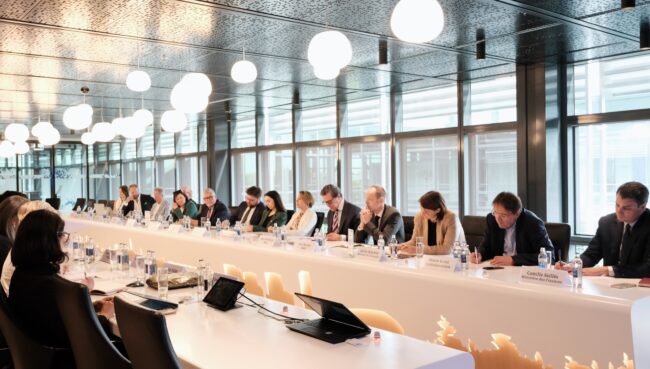
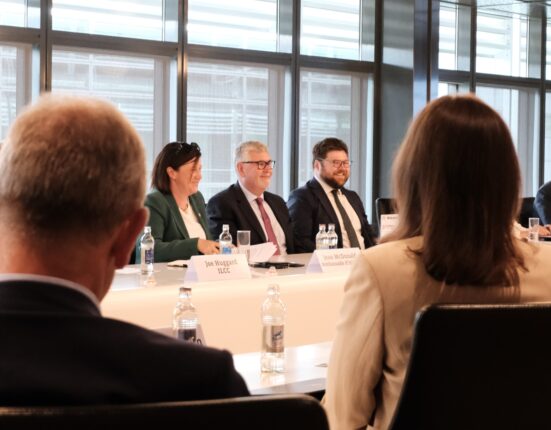
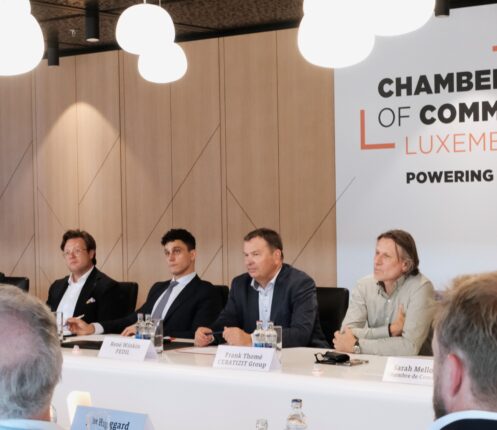
On 7 July 2026, FEDIL, together with H.E. Jean McDonald, Ambassador of Ireland to Luxembourg, hosted an exchange on the priorities of the Irish Presidency of the Council of the European Union.
We were delighted to welcome Pat Ivory and Neil Willoughby from Ibec, who brought the perspective of Irish business to a fruitful discussion with representatives of Luxembourg business associations and chambers, the European Commission, ministries, public agencies and other stakeholders.
The exchange provided a timely opportunity to discuss the Irish Presidency’s priorities while sharing the expectations and concerns of companies operating in an increasingly challenging economic and geopolitical environment.
A clear message emerged: Europe must move from ambition to delivery. For businesses, this means simpler, clearer and more predictable rules — from reporting and labour policy to digital regulation. Key priorities included simplification, a deeper Single Market, the Savings and Investments Union, open trade and investment, and a green transition carried out with industry, not against it.
On the sidelines of the event, FEDIL and Ibec also met with representatives of the Ministry of Foreign and European Affairs to exchange views on international relations and trade policy. The day concluded with a reception generously hosted by Ambassador Jean McDonald, providing a fitting opportunity to continue the discussions in an informal setting.