|
Getting your Trinity Audio player ready...
|
Following a first series in 2025, FEDIL and Luxinnovation are launching a second set of inspiring articles dedicated to promising AI use cases. Published weekly on both organisations’ websites, each feature will introduce an innovative AI project and the forward-looking company behind it.
Bringing innovation to trusted media workflows
Broadcasting Center Europe (BCE), part of RTL Group, is a leading European media services company specializing in content management, broadcasting solutions and digital media infrastructure. Headquartered in Luxembourg, the company develops and operates innovative technologies that help broadcasters and media organizations manage, distribute and monetize audiovisual content in an increasingly complex and fast-moving environment. One of its latest innovations, NxP, illustrates how artificial intelligence can be integrated into mission-critical media operations while preserving editorial control and trust.
The challenge: managing multilingual news at unprecedented speed
Modern newsrooms face a growing challenge. Journalists must process vast quantities of audiovisual content coming from different countries, languages and sources, often under intense time pressure. Before a video can be published or shared internationally, editorial teams typically need to review footage, transcribe speeches, translate content, identify relevant sequences and enrich files with metadata.
These activities are essential but highly time-consuming. In international media networks, language barriers can further slow collaboration and delay access to information. At the same time, the acceleration of news cycles requires media organizations to balance speed, accuracy and editorial responsibility. Traditional content exchange platforms often facilitate file transfer but provide limited support for understanding and contextualizing audiovisual content.
For broadcasters operating across borders, the challenge is no longer simply moving content efficiently. It is about transforming raw footage into actionable editorial information as quickly and reliably as possible.
The solution: AI embedded at the heart of editorial workflows
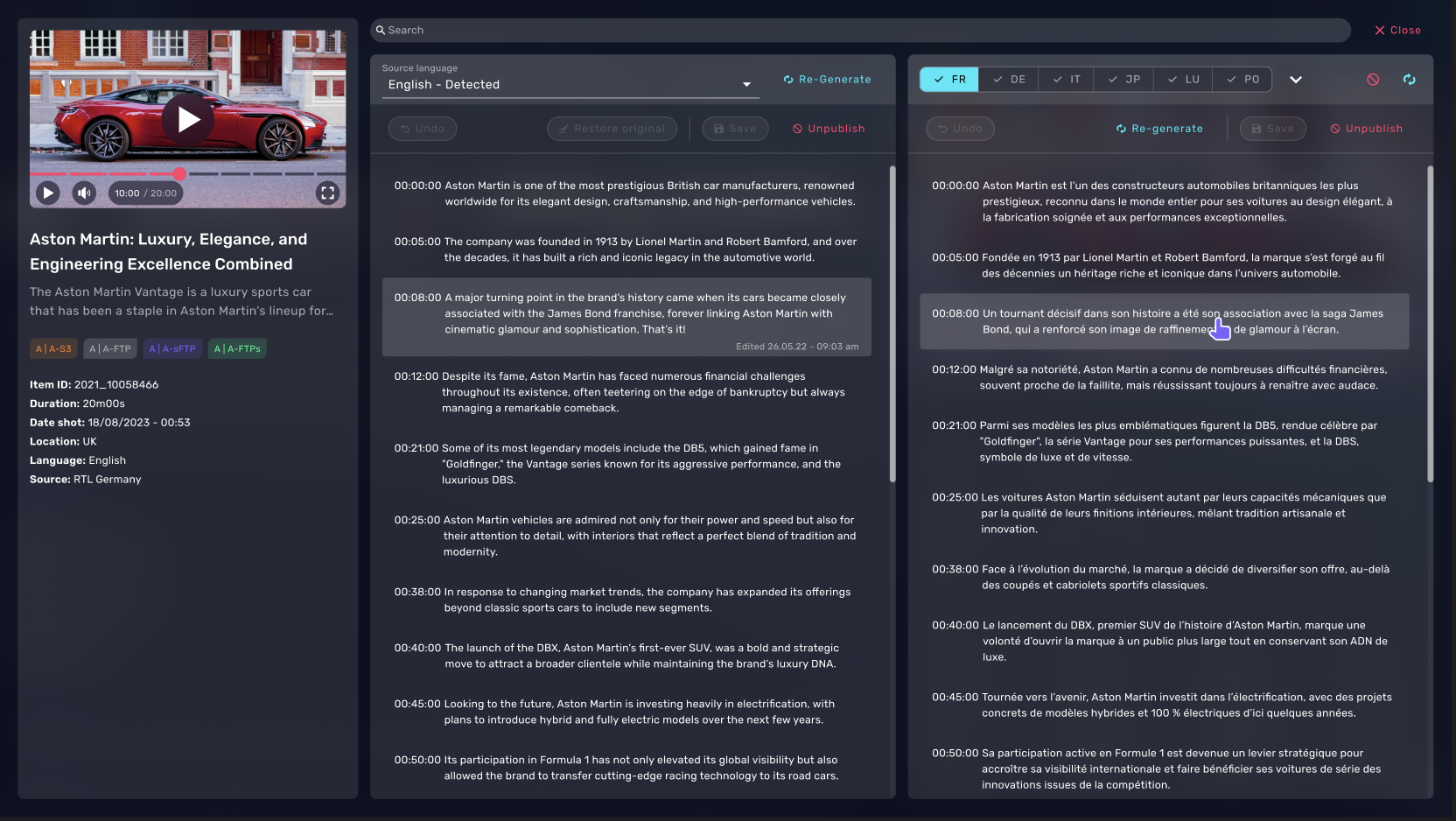
To address these challenges, BCE developed NxP, an AI-augmented multilingual editorial intelligence platform designed specifically for professional newsroom environments. Rather than offering isolated AI features, the platform integrates artificial intelligence directly into the editorial and distribution workflow, enabling journalists to move from raw video content to structured editorial assets in a matter of minutes.
NxP combines several advanced AI technologies within a single operational environment. These include speech-to-text transcription, neural machine translation, AI-assisted summarization, contextual metadata enrichment, key moment detection, face recognition and multimodal video intelligence capable of analysing visual, audio and textual information simultaneously.
The platform automatically transforms audiovisual material into searchable, structured and multilingual content. Journalists can rapidly understand foreign-language footage, generate multilingual versions of editorial content and identify the most relevant segments of a video without manually reviewing entire recordings.
Olivier Waty, Innovation & Partnerships Director, explains the vision that shaped BCE’s approach: “Artificial intelligence is not intended to replace journalists. It should enable them to spend less time on repetitive tasks and more time on what makes their profession valuable: fact-checking, providing context and telling stories. It is this vision that has guided the development of NxP”.
An important differentiator of NxP is its human-in-the-loop approach. AI-generated outputs remain fully subject to editorial review and validation. Journalists retain responsibility for all final decisions, ensuring that automation enhances professional work rather than replacing human expertise.
A scalable and responsible AI architecture
Another key strength of the platform lies in its multi-provider AI strategy. Instead of relying on a single technology vendor, NxP integrates solutions from multiple AI providers, allowing greater flexibility, performance optimisation and long-term resilience. This approach enables continuous adaptation to evolving AI capabilities while reducing dependency on any one technology ecosystem.
Responsibility and transparency were also incorporated from the outset. The platform operates within secure professional media networks accessible only to authorised partners and follows European data protection principles. AI outputs are clearly identified, allowing users to review, modify or reject generated content throughout the workflow. This governance framework helps maintain trust and accountability in environments where the quality and reliability of information are critical.
Measurable impact across international media networks
NxP is already deployed within major international broadcasting ecosystems and demonstrates how AI can deliver tangible value at industrial scale. The platform currently supports the exchange of approximately 9,000 audiovisual assets per month and facilitates the distribution of around 20 hours of audiovisual material every day.
Its reach extends across two major international media networks, including organizations connected to the European Broadcasting Union and ENEX, representing roughly 750 media organizations and partners worldwide. Journalists using the platform benefit from faster processing of audiovisual content, improved multilingual collaboration and accelerated editorial preparation.
By embedding AI directly within trusted media infrastructures, BCE has demonstrated that artificial intelligence can move beyond experimentation to become a practical operational tool. Developed and operated in Luxembourg, NxP is helping create a more efficient, multilingual and collaborative newsroom environment that supports the rapid circulation of trusted information across borders while preserving the essential role of journalistic oversight.