|
Getting your Trinity Audio player ready...
|
In 1951, in a Luxembourg still marked by the aftermath of the war, building and civil engineering contractors decided to join forces under the umbrella of FEDIL and to speak with one voice. Seventy-five years on, the Association of Building and Civil Engineering Contractors represents a sector that has played a pivotal role in transforming the country, whilst undergoing its own transformation. From the ‘Trente Glorieuses’ to the challenges of digitalisation and decarbonisation, via training and social dialogue, its history mirrors that of modern Luxembourg. At a time when the construction industry is entering a new pivotal phase, we look back on 75 years of change and ahead to the challenges facing the sector.
In 1951, Luxembourg was a very different country. It had fewer than 300,000 inhabitants, was only just emerging from the years of reconstruction and was about to experience a period of unprecedented economic growth and transformation. Resources were still limited, and machinery and techniques were nowhere near as advanced as they are today, but the needs were immense. There was a need to rebuild, develop infrastructure and prepare a country entering a new era.
It was against this backdrop that the Association of Building and Civil Engineering Contractors was founded. At its helm was a man who particularly embodied this pioneering spirit: Émile Nennig, its founding president. An engineer and contractor, he realised very early on that companies in the sector, beyond the competition that naturally pits them against one another, needed a united voice to defend their interests and contribute to the decisions that would shape the country’s future. The objective was already clearly set: to bring contractors together so that they could be stronger collectively and help build the country.
Émile Nennig himself was representative of this generation of builders. An entrepreneur but also an innovator, he took a particular interest in new techniques involving concrete and sliding formwork. In the early 1950s, his company was involved in several landmark projects, including the Findel Airport hangar, construction of which began in 1951 and which was, at the time, a particularly bold feat of prestressed concrete engineering.
Builders of the Glorious Thirty
The decades that followed quickly proved the Group’s raison d’être. The ‘Trente Glorieuses’ transformed Luxembourg. The country industrialised, modernised and urbanised. The establishment of the first European institutions marked a new chapter in its history. Roads, bridges, housing, schools, and industrial and administrative infrastructure sprang up. The Kirchberg, still largely agricultural in the early 1960s, gradually became the European and then financial district we know today.
The construction sector has been at the heart of this transformation every step of the way. Buildings were needed to cater for a growing population, a diversifying economy and a country with ever-increasing ambitions. In three-quarters of a century, Luxembourg’s population has more than doubled. The landscape, the towns and the ways in which people live have undergone profound changes.
Through its successive chairmen – including Émile Nennig, Camille Diederich, Christian Thiry and Jean-Marc Kieffer, prior to the current president, Marc Giorgetti, the Association has supported these developments and defended the collective interests of a sector that has become essential to the functioning of the Luxembourg economy. One conviction has run through its 75 years of existence: entrepreneurs do not merely talk about the country’s development; they build it.
But over the past 75 years, the meaning of ‘building’ has changed somewhat.
A profoundly transformed industry
The first major shift has been the transition from quantity-driven construction to an increasingly quality- and sustainability-focused approach. Requirements for structural integrity, cost and timeliness have gradually been joined by demands for energy performance, resource efficiency and a reduced environmental footprint. The decarbonisation of buildings, the reuse of materials, the recycling of waste and the circular economy are now an integral part of the sector’s thinking.
The second revolution is technological. Whereas contractors were still sometimes writing their prices by hand on quotation forms in the early 2000s, buildings are now designed in three dimensions and construction sites are managed using digital tools. BIM, site apps, drones, connected devices, data analytics, prefabrication and 3D printing are gradually transforming the way we design, plan and build. Artificial intelligence is now being added to these tools, opening up new possibilities in terms of design, process optimisation and productivity.
A third transformation specifically concerns the organisation and productivity of construction sites. Construction remains an activity heavily dependent on site conditions, the weather and numerous stakeholders, but it is evolving towards greater planning, industrialisation and precision. Against a backdrop of cost pressures and labour shortages, the ability to build more efficiently is becoming a key factor in competitiveness.
At the same time, the regulatory environment in which companies operate has become considerably more complex. Urban planning, the environment, safety, labour law, public procurement, technical and energy standards, and authorisation procedures: the contractor of 2026 must navigate a range of constraints that the Group’s founders could scarcely have imagined in 1951. This evolution also explains why the role of collective representation remains as important as ever.
Finally, the fifth major shift is a human one. Over the past 75 years, the construction sector in Luxembourg has become considerably more internationalised, whilst the trades have become more professionalised and specialised. The skills required on a building site are constantly evolving as techniques, materials and regulatory requirements change.
Building is, first and foremost, about investing in people
Despite technological advances, a building site remains, above all, a human endeavour. The sector is not just about concrete, steel, machinery and technology: it relies, first and foremost, on the men and women who design the projects and turn up on site every day.
Over the decades, training has therefore become one of the Group’s key priorities. A decisive milestone was reached in 2002, one year after its 50th anniversary, with the creation and funding of the Institut de Formation Sectoriel du Bâtiment (IFSB). The ambition was clear: to raise vocational and technical training to a higher level and to support the transformation of a profession often still perceived as essentially manual into an increasingly complex and technology-driven sector.
Nearly a quarter of a century later, the figures illustrate just how far we have come. More than 100,000 trainees from over 100 different nationalities have undertaken training at the IFSB since its inception. From apprentices to experienced site managers, the training programmes cover professional skills as well as health and safety and new skills related to digitalisation.
The IFSB is now part of a wider ecosystem. Together with NeoBuild and Cocert, the various organisations have been brought together under the BAU Foundation, with the aim of preparing the sector for the transformations of the coming decades.
The stakes are all the higher given that the battle for skills is far from over. According to industry estimates, more than 10,000 people will need to be recruited in the coming years in the construction sector alone to offset those retiring. The ability to attract a new generation, to promote trades that have undergone profound changes, and to provide ongoing training for staff is therefore becoming a prerequisite for Luxembourg’s very ability to continue building.
Social dialogue as a constant
The issue of people is also inextricably linked to that of social dialogue. This has been part of the Groupement’s history since its inception. From the post-war period onwards, the sector’s professional organisation has been closely linked to the emergence of the first collective agreements in the construction industry.
Seventy-five years on, the collective agreement remains a cornerstone of the sector’s organisation and of industrial peace. The Group embraces this responsibility towards company staff, even during periods when economic conditions place significant pressure on costs and margins. At the same time, however, it calls for the working framework to be adapted to the specific realities of construction sites, which are subject to deadlines, seasonal variations and weather conditions.
Training, safety, social dialogue, the appeal of the trades: behind the technical transformations in the construction industry, the human aspect thus remains a constant. It could even become even more crucial as the skills required become more diverse.
75 years, and new projects
The Group is celebrating its anniversary at a significant time for the Luxembourg construction industry. After several years of crisis, the sector must both regain momentum and meet the considerable needs of a country whose population and economy continue to evolve.
Housing lies at the heart of this equation. It alone accounts for 30 per cent of construction activity and therefore accounts for a significant proportion of the sector’s jobs, machinery and capacity. How can this market be revitalised in a sustainable way, and what lessons can be learnt from recent years? We put this question to Marc Giorgetti, president of the Association of Building and Public Works Contractors.
“The real challenge is to restore the balance between supply and demand”
Mr Giorgetti, housing accounts for around 30 per cent of the construction sector’s activity. After several years of crisis, and whilst certain indicators point to a recovery in transactions, what is your current assessment of the Luxembourg property market? Can we really talk of a recovery?
Marc Giorgetti: We must remain cautious. We have indeed seen a recovery in transactions, particularly from the end of 2024 onwards, driven by changes in financing conditions and measures taken by the government. But that does not mean the housing crisis is behind us.
The underlying problem remains the same: demand for housing remains structurally high, whilst supply is not keeping pace. Luxembourg’s population continues to grow and household structures are changing. We have more single people and small households, yet our approach to housing planning has not always adapted to this reality. At the same time, building new homes requires available land, funding, planning permission, infrastructure and construction capacity. At present, this entire process is not moving fast enough.
The price correction observed between 2022 and 2024 was primarily linked to the interest rate shock and the fall in transactions. It did not resolve the market’s structural imbalance. As soon as demand returns, we see that pressures can re-emerge quickly. A market can become active again without becoming affordable. It is this distinction that is important.
What conclusions should we draw from this? Is there a risk that prices will rise sharply again if housing production does not pick up quickly enough?
That is indeed the risk. If we merely stimulate demand without increasing supply, we will automatically put pressure on prices once again. The real challenge, therefore, is not simply to get transactions moving again: we need to restore a better balance between supply and demand.
This means we must be able to build more homes, but also to build them where the need exists. We must make use of building land, speed up procedures and better adapt our planning to the country’s demographic and economic realities.
The public sector also has a vital role to play. The State and local authorities own land. We believe they must develop and build on this land more extensively in order to create additional supply, particularly of affordable rental housing. The City of Luxembourg has shown that this can work. We must now succeed in speeding up this type of project and, to do so, the public sector must also be able to overcome the complexity of its own procedures.
What, then, are the priority measures the Group is calling for to enable companies to build more again and help make housing more accessible?
We need to act on several fronts simultaneously. The first is to revitalise the off-plan sales market (VEFA). We need investors to return to the market, because without buyers and investors, projects simply do not get off the ground. The measures recently taken by the government are a step in the right direction, but we must continue to create the conditions necessary to launch new projects.
The second challenge concerns financing. We need banks to continue supporting viable projects and entrepreneurship. Following the difficulties of recent years, access to finance remains crucial to enabling the market to recover.
Finally, we must make much faster progress on streamlining administrative procedures. Businesses cannot wait years to obtain the necessary authorisations for a project. We must reduce processing times, clarify responsibilities and translate our ambitions for simplification into concrete procedural changes. The principle of ‘silence implies consent’ could, in particular, be a promising avenue if it is made fully operational.
And we must not forget the issue of labour. Our construction sites are subject to specific constraints, particularly weather conditions and very tight deadlines. We need labour legislation that offers greater flexibility whilst safeguarding employees’ rights. For us, flexibility and protection need not be at odds with one another: a company’s competitiveness is also what enables it to safeguard jobs in the long term.
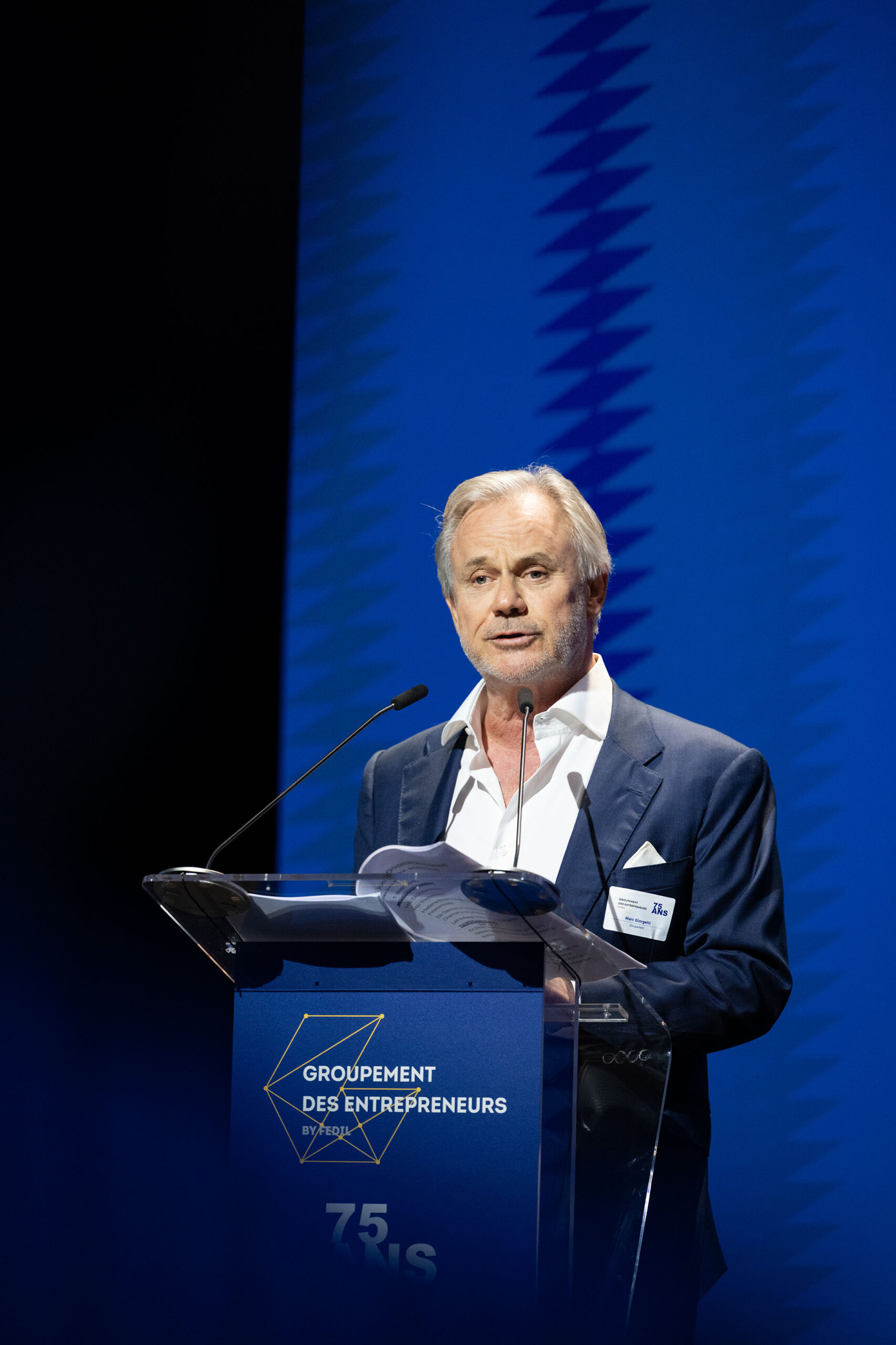
The Group is celebrating its 75th anniversary. If you were to look ahead to 2051, when it will mark its centenary, what sort of construction sector would you like to see in Luxembourg, and what role would you like the Group to continue to play?
Above all, I would like us to have preserved what makes our sector so strong: its ability to adapt and to actively shape the country’s future. Over the past 75 years, our companies have undergone considerable transformation. They have embraced new technologies, new standards, new environmental requirements and new ways of working. They will continue to do so.
But technology will never replace people. Our future will also depend on our ability to attract young people, to train our staff and to offer them prospects in professions that are becoming increasingly technical and specialised. This is the very purpose of the investment we have made in the IFSB since 2002 and which we are continuing today through the BAU Foundation. More than 100,000 people have already been trained there: this is probably one of the achievements of which the Group can be most proud.
As for the Group, I hope it remains what it has been since 1951: a strong, united voice for entrepreneurs, but also a place where we can anticipate change rather than simply endure it. If, on our centenary in 2051, the generation that succeeds us can feel that we have taken the right decisions today to secure the sector’s future, then we will have fulfilled our mission.